Canada
 USA
USA Japan
Japan

The Next Decade in Solar Street Lighting: 3 Revolutionary Technologies on the Horizon

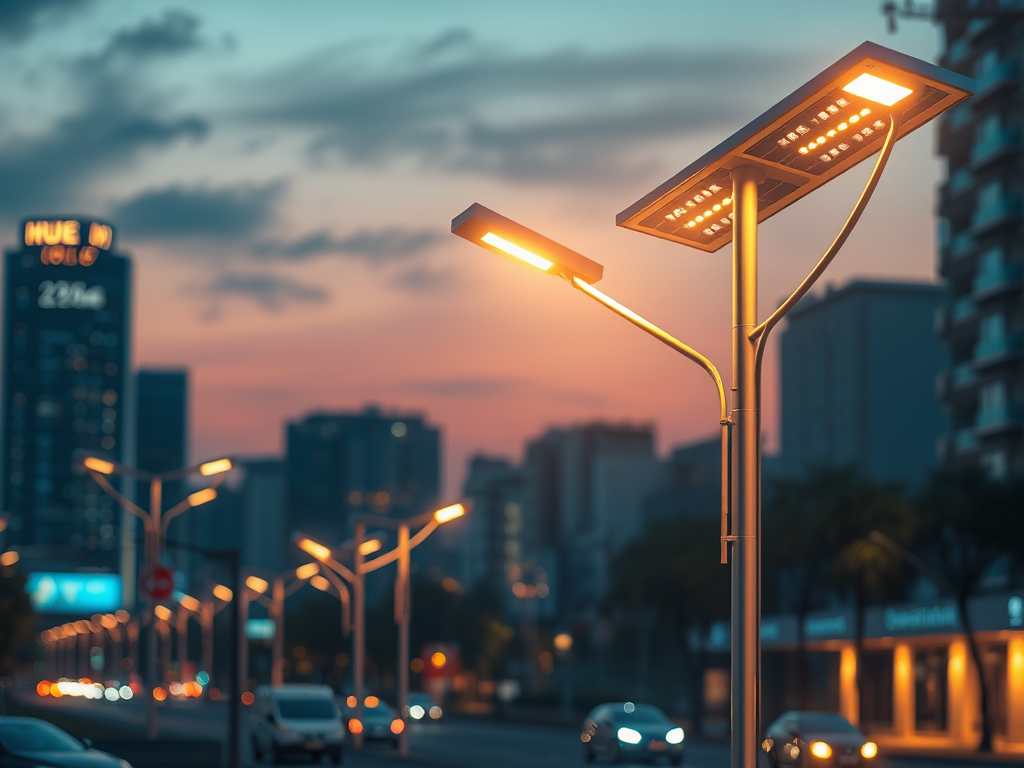
What’s next for solar lights? Explore 3 emerging technologies: perovskite solar cells, AI-powered energy management, and light communication (LiFi) that will reshape smart cities.
The solar street lighting industry is moving at lightning speed. The systems of 2030 will bear little resemblance to today’s already advanced models. They will be more efficient, intelligent, and integrated into the fabric of the smart city. Here are three revolutionary technologies poised to redefine the market.
- Perovskite Solar Cells: A Quantum Leap in Efficiency
The Current Limit: Silicon-based panels are nearing their theoretical efficiency limit (~29%). Commercial monocrystalline panels are at 22-24%.
The Perovskite Promise: This new class of materials can be printed like ink and layered on surfaces. It has achieved over 25% efficiency in labs and has a theoretical limit above 33%.
Impact on Street Lights:
Smaller, More Powerful Panels: A panel half the size could generate the same power, allowing for sleeker designs or more power in compact spaces.
Flexible & Integrated Designs: Perovskites can be applied to curved surfaces, potentially integrating the solar cell directly into the pole or luminaire housing.
Lower Production Cost: The manufacturing process is less energy-intensive than purifying silicon.
Timeline: Commercial viability is expected within 3-5 years. Durability and long-term performance in outdoor conditions are the final hurdles being overcome.
- AI-Predictive Energy Management & Fleet Learning
Today’s smart controllers react (to motion, to ambient light). Tomorrow’s will predict and optimize.
How it Works: Each light, equipped with simple sensors, will feed data (sunlight harvested, energy consumed, traffic patterns) to a cloud-based AI. The AI will analyze patterns across an entire city’s fleet.
Predictive Capabilities:
Weather-Adaptive Scheduling: The system will pull local hyper-accurate weather forecasts. If a 3-day storm is predicted, it will pre-charge batteries to 100% and implement aggressive energy-saving dimming proactively.
Traffic Flow Optimization: Lights will brighten ahead of predicted traffic surges (e.g., before a stadium lets out) and dim on consistently empty roads, improving both safety and efficiency.
Predictive Maintenance: The AI will identify patterns indicating a failing battery (e.g., slower charge rates) and dispatch a work order before the light goes dark.
Timeline: Early versions are in pilot projects now. Widespread adoption will occur alongside 5G and IoT sensor rollouts over the next 5-7 years.
- LiFi (Light Fidelity) & Integrated Multifunction Poles
The light pole will cease to be just a lighting device and become a multi-service network node.
LiFi Technology: LEDs can be modulated at extremely high speeds invisible to the human eye to transmit data. A street light could provide high-speed, secure wireless internet to vehicles, pedestrians, and nearby buildings within its beam.
The “Swiss Army Knife” Pole: Future poles will integrate:
5G/6G Small Cells for wireless carriers.
Edge Computing Nodes for processing local IoT data (from traffic, air quality, and security cameras).
Dynamic Public Information Displays or emergency alert systems.
Distributed Energy Resource (DER) Node: Feeding excess solar power into a microgrid or charging parked EVs.
Impact: This turns the street lighting infrastructure into a revenue-generating asset for cities, offsetting its cost and accelerating adoption.
Preparing for the Future Today:
As a buyer or specifier, the choices you make now should be future-adaptable:
Choose Modular Systems: Select lights where the controller, battery, and communication module can be easily upgraded without replacing the entire pole and fixture.
Insist on Open APIs: Ensure the smart controller’s software has an open application programming interface (API) to allow integration with future city management platforms.
Prioritize Data: Choose systems that collect and provide access to performance data—this data will be the foundation for future AI optimization.
The solar street light is evolving from an off-grid appliance into the central nervous system of the smart, sustainable, and connected city. The future is not just bright—it’s intelligent.
Internal Link Suggestion: Stay ahead of the curve. Subscribe to our Technology Insights Newsletter for updates on these emerging trends.