Canada
 USA
USA Japan
Japan

Solar Street Light Cost Breakdown 2024: Installation, Hardware, and 10-Year Total Cost Analysis

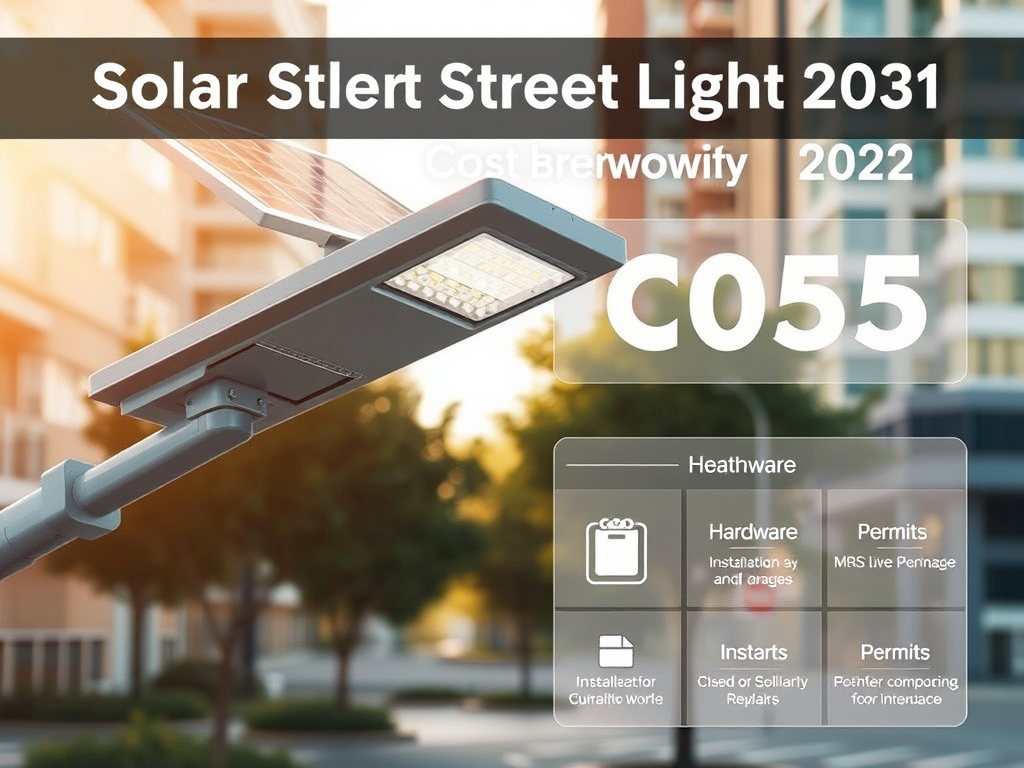
What’s the real cost of solar street lights? We break down hardware, installation, and 10-year total cost vs. traditional lights. Get a free interactive cost calculator.
“How much do solar street lights cost?” This is the first question every project manager asks. The answer isn’t a single number—it’s a comparison between a higher upfront investment and massively lower long-term operating costs. This 2024 breakdown gives you the transparent numbers to build your business case.
Part 1: Upfront Cost Breakdown (CAPEX)
For a commercial-grade, all-in-one solar street light (120W LED, 300W panel, LiFePO4 battery, 20ft galvanized pole), here’s the typical cost structure:
Cost Component Price Range Notes & Variables
- Hardware (Light Unit) $600 – $1,200 per unit Depends on LED brand (Cree/Bridgelux), battery capacity (3-day vs. 5-day autonomy), and smart features (basic timer vs. IoT).
- Pole & Foundation Kit $300 – $700 per pole Height (15ft vs. 30ft), wind rating, and foundation size (soil type affects concrete volume).
- Installation Labor $200 – $500 per light Highly variable. Lower for rural areas with easy access; higher for urban settings requiring traffic control or difficult terrain.
- Permits & Engineering $100 – $300 per light Site plans, electrical permits (if any), structural stamp for wind load. Often a fixed project fee.
- Freight & Logistics $50 – $150 per light Bulk shipping from manufacturer to site.
Total Installed Cost Per Light $1,250 – $2,850 Average for a quality system: ~$1,800/light.
Part 2: The Operating Cost (OPEX) – Where Solar Wins
Compare this to a traditional grid-tied LED light over 10 years (120W LED, 12hrs/night, $0.12/kWh, with trenching):
Cost Category Traditional Grid LED (120W) Solar LED (120W) 10-Year Savings with Solar
Energy Cost ~$630/year $0/year $6,300
Grid Connection & Trenching $3,000 – $8,000 (one-time) $0 $3,000 – $8,000
Maintenance $100/year (bulb/ballast) $30/year (panel cleaning, battery check) $700
Total 10-Year Cost $10,300 – $15,300 ~$1,800 (CAPEX) + $300 = $2,100 $8,200 – $13,200
Key Insight: The solar system’s higher CAPEX is offset in 2-4 years by eliminating grid energy and trenching costs. Years 5-10 represent pure savings.
Part 3: Factors That Drastically Affect Your Project’s Cost
Quantity: Bulk purchases (100+ units) can reduce hardware costs by 15-25%.
Local Labor Rates: Get 3 quotes from local electrical contractors familiar with solar.
Site Conditions: Rocky soil = higher excavation cost. Easy soil = lower cost.
Incentives: Remember, the 30% Federal ITC for commercial projects can reduce your net CAPEX by nearly one-third.
Part 4: Hidden Costs to Watch Out For (The “Gotchas”)
Underspecifying the Battery: A cheap battery that fails in 3 years adds a $300+ replacement and labor cost. Invest in LiFePO4.
Poor Installation: Incorrect tilt angle or shading can reduce performance by 30%, effectively increasing your “cost per delivered lumen.”
Unreliable Supplier: Lack of warranty support turns a minor fault into a full unit replacement cost.
Actionable Advice:
Get Itemized Quotes: Demand quotes that separate hardware, pole, and installation.
Model the TCO: Use our calculator (link below) or a simple spreadsheet:
(Solar CAPEX – Incentives) vs. (Grid CAPEX + (Annual Energy Cost * 10))
Consider a Pilot: Install 3-5 lights as a pilot to verify performance before a full rollout.
The financial argument for solar street lights is now overwhelming for most projects. It’s a capital investment that pays a guaranteed, inflation-protected dividend in the form of eliminated electricity bills for 25 years.
Internal Link Suggestion: Download our free Interactive TCO Calculator (Excel) to input your local energy rates and get a precise payback period.