Canada
 USA
USA Japan
Japan

Battery Showdown: LiFePO4 vs. Standard Lithium-Ion for Solar Street Lights

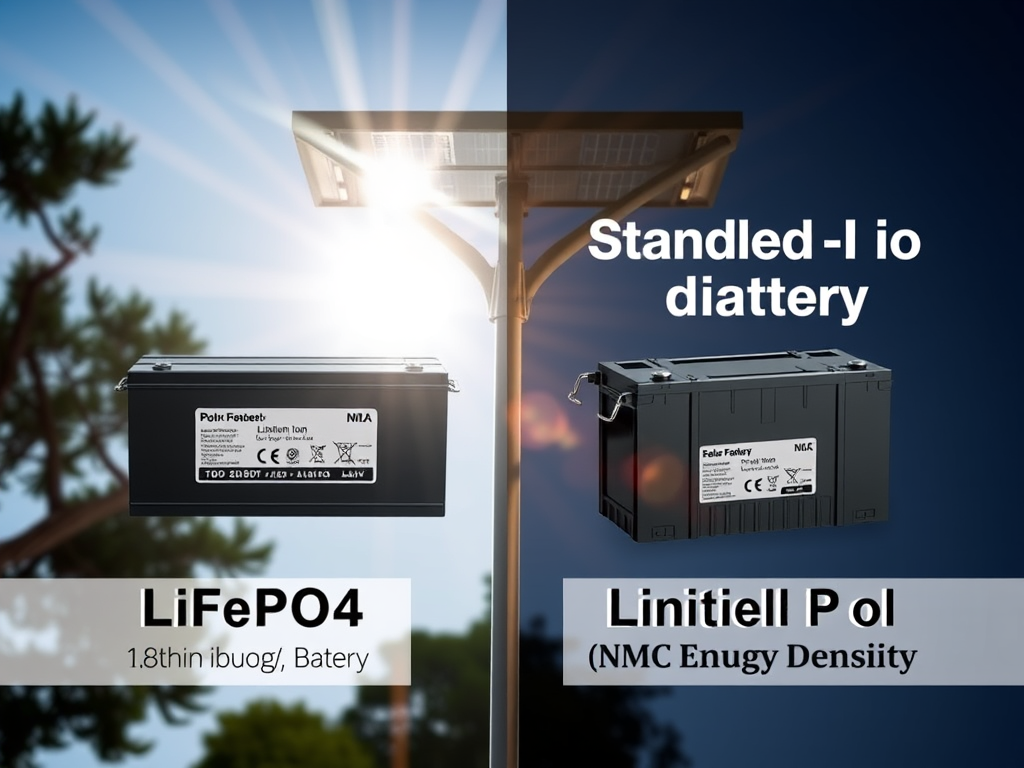
Choosing a battery? We compare LiFePO4 vs. standard Lithium-Ion on safety, lifespan, cost, and temperature performance for solar lighting. See the clear winner.
The battery is the most critical—and often most misunderstood—component of a solar street light. It stores the sun’s energy for the night. For years, the debate was between Lead-Acid and Lithium. Today, within the lithium category, a new champion has emerged: Lithium Iron Phosphate (LiFePO4 or LFP). Let’s compare it to the older Lithium Nickel Manganese Cobalt Oxide (NMC) technology common in consumer electronics.
The Contenders: A Quick Introduction
Lithium-Ion (NMC): The high-energy-density chemistry found in phones, laptops, and EVs. Known for compact size per kWh.
Lithium Iron Phosphate (LiFePO4): A newer chemistry gaining rapid dominance in stationary storage (solar, UPS) and commercial applications. Known for exceptional safety and longevity.
Head-to-Head Comparison
Feature Lithium-Ion (NMC) Lithium Iron Phosphate (LiFePO4) Winner & Why
Cycle Life (to 80% capacity) 1,000 – 2,000 cycles 3,000 – 7,000+ cycles LiFePO4. 2-3x longer life. A light cycling daily lasts 8-10+ years vs. 3-6.
Thermal & Chemical Stability Moderate. Prone to thermal runaway at high temps or if damaged. Requires complex BMS. Excellent. Extremely stable cathode material. Much higher tolerance to overcharge/heat. LiFePO4. Dramatically safer, reducing fire risk in sealed enclosures.
Operational Temperature Range Performance degrades rapidly below 0°C (32°F). Charging in cold can cause permanent damage. Performs well in a wider range. Can be charged at lower temperatures (down to -20°C/-4°F with some models). LiFePO4. More reliable for year-round operation in most climates.
Energy Density (Wh/kg) 150 – 250 Wh/kg 90 – 160 Wh/kg NMC. It’s more compact and lighter for the same capacity.
Cost Moderate to High (per cycle) Slightly Higher Upfront, but Lower per Cycle LiFePO4. The longer lifespan makes it cheaper over the life of the project (Lower TCO).
Depth of Discharge (DoD) Recommends ~80% DoD for longevity. Can routinely be discharged to 100% DoD without significant degradation. LiFePO4. You can use more of the rated capacity daily.
Environmental Impact Contains cobalt & nickel (expensive, ethical sourcing concerns). Uses iron & phosphate (abundant, non-toxic, easier to recycle). LiFePO4. More sustainable and ethical supply chain.
The Verdict for Solar Street Lights: LiFePO4 is the Unambiguous Choice
For a commercial or municipal solar street light that must operate reliably for a decade with minimal maintenance, LiFePO4 is the superior and recommended technology. Here’s why:
Total Cost of Ownership (TCO): While the initial battery cost may be 10-20% higher, its 3x longer lifespan means you avoid 2-3 replacement cycles of NMC batteries. This saves thousands in labor and parts over 15 years.
Safety is Non-Negotiable: These batteries are installed in public spaces, often in sealed compartments. LiFePO4’s resistance to thermal runaway is a critical risk-mitigation feature.
Set-and-Forget Reliability: Its wide temperature tolerance and ability to handle deep discharges mean the system is more forgiving of less-than-perfect conditions, leading to fewer callbacks and failures.
When Might NMC Still Be Used?
In applications where extreme weight or size constraints are the absolute top priority, and the product has an integrated, sophisticated thermal management system (like an EV). For 99% of stationary solar lighting, this is not the case.
What to Ask Your Supplier:
“Is the battery LiFePO4 (LFP) chemistry?”
“What is the warranty in years and cycles?” (Look for at least a 5-year, 3500-cycle warranty).
“Does the Battery Management System (BMS) have low-temp charging protection?”
Insist on LiFePO4. It’s the modern standard for a reason, ensuring your lighting project is safe, durable, and cost-effective for the long term.
Internal Link Suggestion: *All our commercial series lights come standard with UL-certified LiFePO4 batteries. See the detailed battery specs on our technology page.