Canada
 USA
USA Japan
Japan

The Ultimate Buyer’s Guide: How to Choose the Right Solar Street Lights in 2024

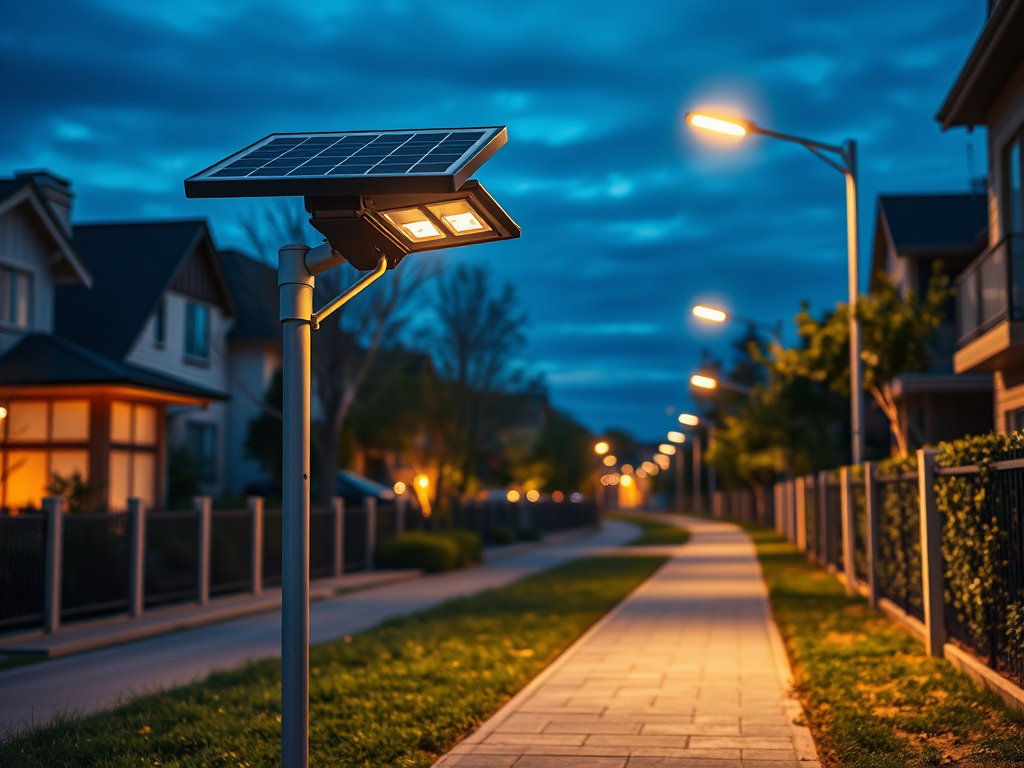
Buying solar street lights? Avoid costly mistakes. Our 2024 guide covers 6 essential factors: lumens, battery days of autonomy, smart controls, and warranty terms.
The solar street light market is crowded with options ranging from suspiciously cheap to premium. Choosing the wrong system leads to dark nights, frequent failures, and a wasted investment. This guide cuts through the noise, giving you the 6 non-negotiable factors to evaluate.
Factor 1: Understand Your Lighting Need – It’s Not Just Watts
Forget comparing “100W” lights. What matters is light on the ground.
Luminous Flux (Lumens): This is total light output. A residential path may need 3,000-6,000 lumens, while a main road needs 12,000-20,000+.
Luminous Efficacy (Lumens/Watt): Measures efficiency. Look for LEDs with 140-200 lm/W. Higher is better.
Ask for an IES File or Photometric Diagram from the supplier. This shows the exact light distribution pattern (e.g., Type III for roadways, Type V for parking lots).
Factor 2: Solar Panel & Battery – The Heart of the System
Panel Type & Size: Insist on Monocrystalline (20%+ efficiency). The panel wattage should be 2.5 to 3.5 times the luminaire wattage to account for rainy days and winter. A 120W light needs at least a 300W panel in most climates.
Battery Chemistry & Capacity:
LiFePO4 (Lithium Iron Phosphate) is the industry standard for good reason: 5-8 year lifespan, 3500+ cycles, safe, and performs well in heat/cold.
Capacity (Ah): This determines “Days of Autonomy.” A quality system should provide 3-5 days of operation without sun. For a 120W light running 10 hours nightly, you’d need approx. a 100Ah @ 12V LiFePO4 battery.
Factor 3: The Intelligence of the Controller
The controller is the brain. It must have:
MPPT (Maximum Power Point Tracking): Increases solar charging efficiency by 15-30% over cheap PWM controllers.
Adaptive Dimming Schedules: Programmable time-based dimming (e.g., 100% for 4 hours, then 50% until dawn).
Motion Sensor Compatibility: Triggers bright light on demand for security and saves energy.
Remote Monitoring (IoT): For commercial projects, the ability to monitor each light’s status, fault codes, and energy data via a dashboard is invaluable.
Factor 4: Durability & Environmental Ratings
Ingress Protection (IP) Rating: The luminaire and battery box should be rated IP65 or higher (dust-tight and protected against water jets).
IK Rating (Impact Resistance): IK08+ means the fixture can withstand impacts of 5 joules (equivalent to a 1.7kg mass dropped from 30cm), crucial for vandal-prone areas.
Operating Temperature Range: Ensure it covers your local extremes, e.g., -40°F to 140°F (-40°C to 60°C).
Factor 5: Pole & Mounting Integrity
The light must stay upright. Ensure the pole:
Is hot-dip galvanized steel for corrosion resistance.
Meets local wind load standards (e.g., ASTM, EN40).
Has a foundation design provided by the supplier or a local engineer.
Factor 6: Warranty & Supplier Reputation
A trustworthy warranty looks like this: “5-year comprehensive warranty covering LED, solar panel, battery, and controller.” Be wary of vague or segregated warranties (e.g., “5 years on panel, 2 years on battery”).
Ask for: References from past projects in a similar climate. A reputable supplier will provide them.
Your Decision Checklist:
Required ground-level illuminance and light pattern confirmed.
Monocrystalline panel wattage is 3x the LED wattage.
Battery is LiFePO4 with 3+ days of autonomy.
Controller has MPPT and programmable dimming.
IP65 & IK08 ratings are confirmed.
A clear, comprehensive 5-year warranty is offered.
Internal Link Suggestion: Use our interactive Solar Light Configurator to specify your project needs and get a tailored product recommendation