Canada
 USA
USA Japan
Japan

Solar Panel Efficiency Explained: How to Choose the Right One for Your Street Light Project

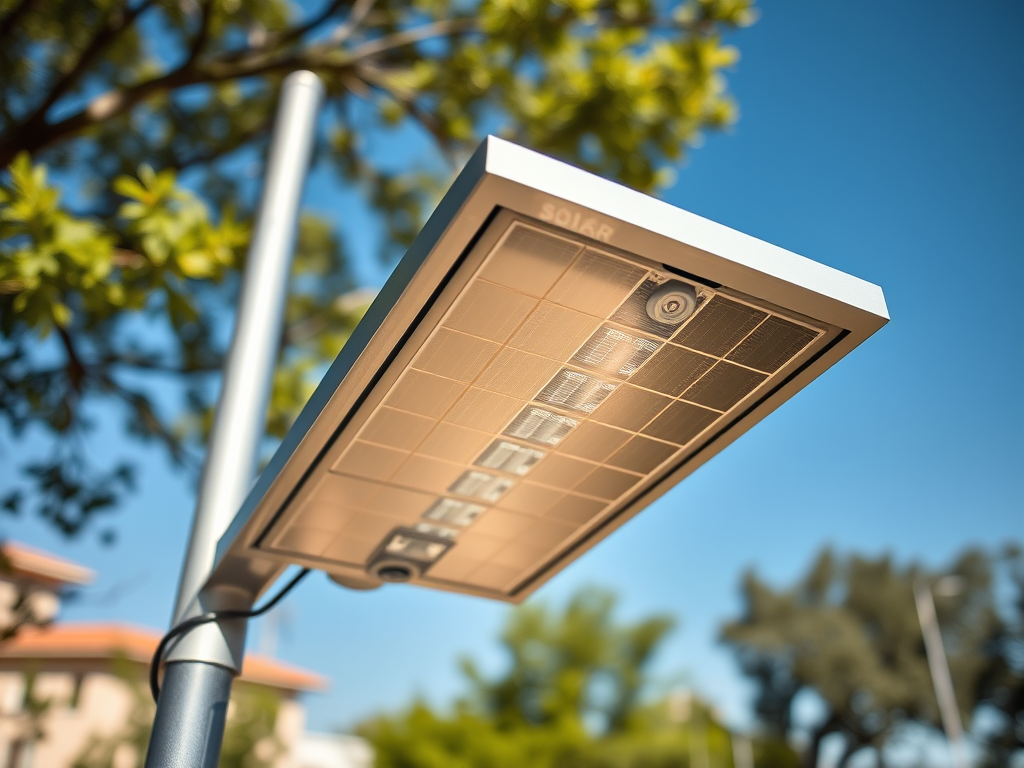
Confused by solar panel efficiency ratings? Our guide breaks down monocrystalline vs. polycrystalline panels and how they impact your street light’s performance. Get the facts.
The solar panel is the heart of any off-grid lighting system. Its efficiency directly determines how much energy is harvested during the day to power the night. But what does “efficiency” really mean, and how much does it matter for your project?
Understanding the Numbers: It’s All About Surface Area
Panel efficiency is the percentage of sunlight hitting the panel that gets converted into usable electricity. A 22% efficient panel generates more power from the same footprint than a 17% efficient one.
For a street light requiring 100W: You might need a 300W, 17% efficient panel (approx. 1.8 sq.m) or a more compact 220W, 22% efficient panel (approx. 1.1 sq.m).
The Great Debate: Monocrystalline vs. Polycrystalline
Monocrystalline Panels (Mono-Si)
Efficiency: 20-24% (Industry leader for high-end projects).
How they’re made: From a single, pure silicon crystal.
Pros: Highest efficiency and lifespan; performs better in low-light and high-temperature conditions.
Cons: More expensive per watt.
Best for: Projects with limited space on the fixture, areas with cloudy weather, or when a sleek, black aesthetic is desired.
Polycrystalline Panels (Poly-Si)
Efficiency: 15-20% (A cost-effective workhorse).
How they’re made: From fragments of silicon melted together.
Pros: Lower manufacturing cost, making the initial system price more affordable.
Cons: Larger size needed for the same output; slightly lower heat tolerance.
Best for: Large-scale deployments where pole-top space isn’t a constraint and the primary goal is minimizing upfront cost.
Beyond the Panel: Real-World Factors That Kill Efficiency
The lab-rated efficiency is one thing; real-world performance is another. Four critical factors can derail your system:
Temperature Coefficient: For every degree above 25°C (77°F), panel output drops by about 0.3-0.5%. Proper heat dissipation is critical.
Soiling Loss: Dust, bird droppings, and pollen can reduce output by 15-25% if not cleaned quarterly.
Angling and Orientation: A panel fixed at the wrong tilt angle can lose 10-30% of its potential yield. We recommend a seasonal tilt adjustment for latitudes above 30°.
Shading: Even partial shading on one cell can disproportionately reduce the output of the entire panel. Use panels with bypass diodes to mitigate this.
Our Practical Recommendation
For 99% of commercial and municipal street lighting projects, we recommend high-efficiency monocrystalline panels. The higher initial cost is justified by reliable performance in diverse weather, longer service life, and a smaller, more vandal-resistant footprint.
For a budget-conscious, large-scale farm or perimeter lighting project with ample space, polycrystalline panels can be a viable option.
Always request the panel’s datasheet and check its temperature coefficient and performance warranty (e.g., 90% output after 10 years, 80% after 25 years).
Internal Link Suggestion: *All our commercial-grade solar street lights feature tier-1 monocrystalline panels. Compare specifications in our detailed product guide