Canada
 USA
USA Japan
Japan

Save Money with LED Bulbs: The Real Cost Explained

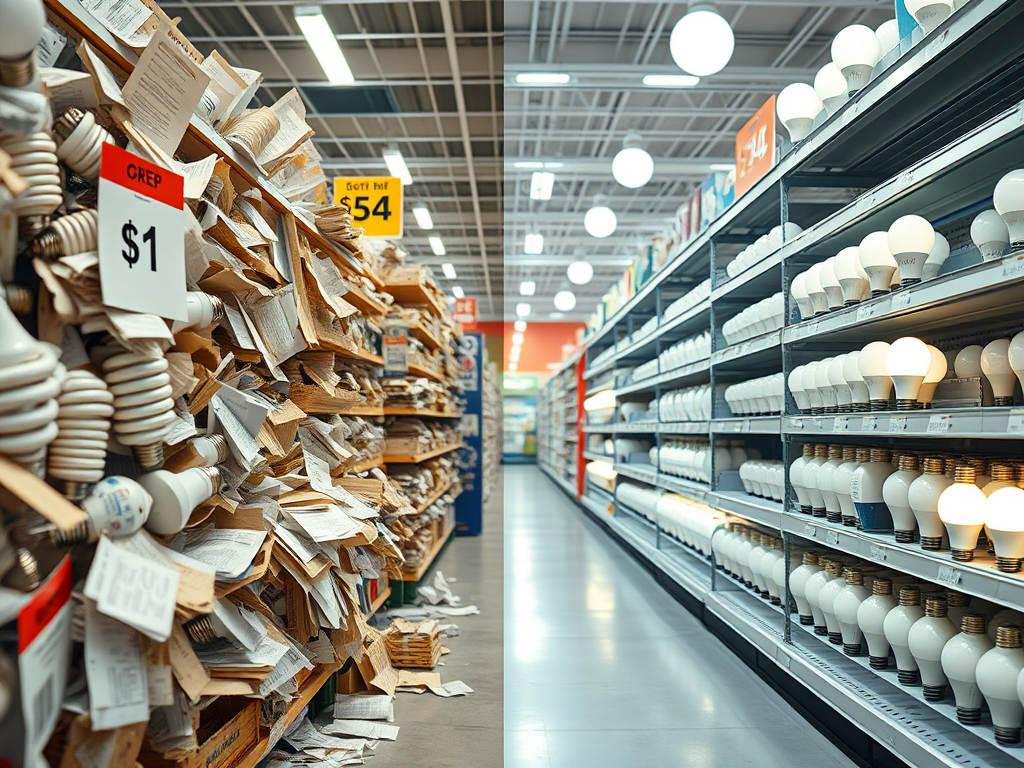
Ever notice how every big-box store buries the LED bulbs in the back corner? While the cheap incandescents are right up front by the registers?
There’s a reason: Profit.
See, stores make more money when you buy cheap bulbs repeatedly. That $1 incandescent you grab on impulse? You’ll be back in 3 months for another. And another. And another.
The $4 LED in the back? You’ll buy it once. Maybe twice in a decade.
But here’s what they’re counting on you not knowing:
The real cost isn’t the sticker price. It’s the electricity.
Let’s say you buy 4 incandescents for $1 each. Over their combined 4,000-hour lifespan (4 bulbs × 1,000 hours), they’ll use:
240 kWh (60 watts × 4,000 hours ÷ 1000)
At $0.15/kWh = $36 in electricity
Total cost: $4 (bulbs) + $36 (electricity) = $40
One LED for $4 lasting 4,000 hours:
36 kWh (9 watts × 4,000 hours ÷ 1000)
Electricity: $5.40
Total cost: $4 (bulb) + $5.40 (electricity) = $9.40
You save $30.60 by walking to the back of the store.
But Walmart’s not stupid. They’re playing the long game:
They save too – Every Walmart store has about 10,000 light fixtures. Switching to LEDs saves a typical supercenter $50,000/year in electricity. They’ve converted all 4,700 U.S. stores.
They know you’ll buy other stuff – When you save $30 on electricity, you might spend it at… Walmart.
They’re phasing out incandescents anyway – Federal efficiency standards are making old bulbs obsolete. The cheap ones up front? They’re clearing inventory.
So next time you’re tempted by the $1 bulbs at the register, walk to the back. Find the LED multipacks (better price per bulb). Check for utility rebate stickers (many offer $1-3 off).
And remember: The store layout is designed to maximize their profit, not yours. Your job is to see past the marketing to the real math.
Because while Walmart’s counting on you buying cheap bulbs every few months, your bank account would rather you buy smart once.