Canada
 USA
USA Japan
Japan

From Dumb Poles to Smart Data Nodes: How IoT is Revolutionizing Solar Street Light Management

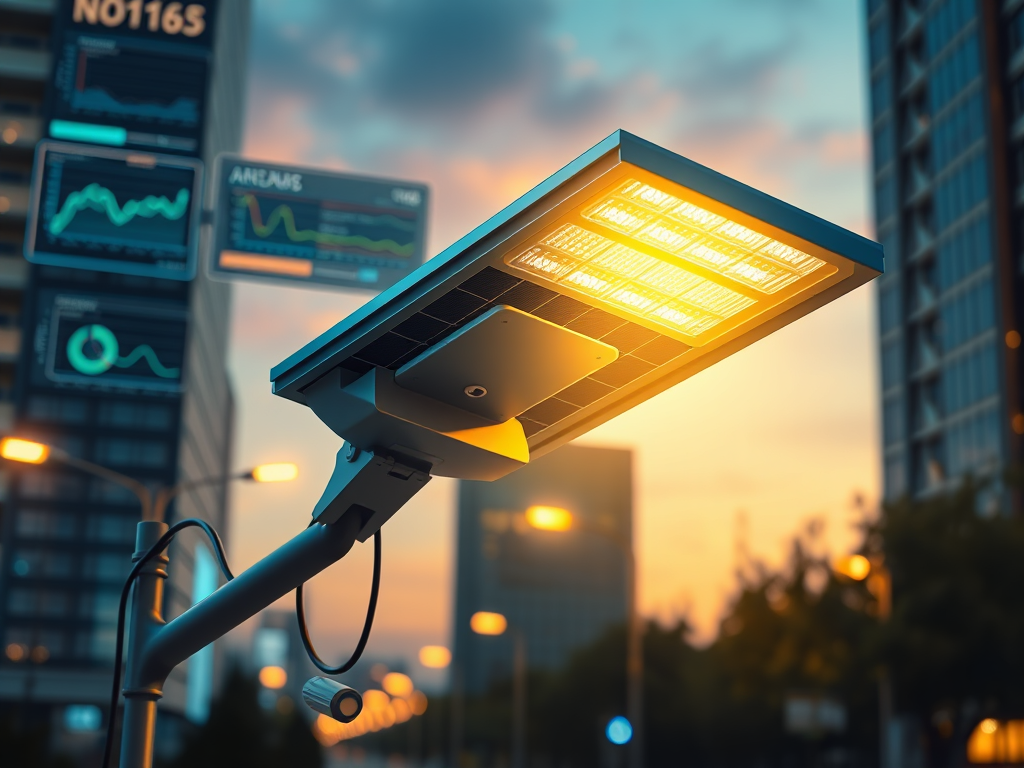
Modern solar lights generate critical data. Learn how IoT platforms use analytics to predict failures, optimize energy use, and turn lights into city sensors.
The true revolution in modern solar street lighting isn’t just that they’re off-grid—it’s that they’re intelligent data-generating assets. With integrated IoT (Internet of Things) sensors and connectivity, each light becomes a node in a smart city network, shifting management from reactive maintenance to predictive optimization.
What Data Does a Smart Solar Street Light Generate?
A typical IoT-enabled light monitors and transmits:
Performance Data: Panel voltage/current, battery state-of-charge (SOC), battery temperature, load current, lumen output.
Operational Data: On/off status, dimming level, motion sensor triggers.
Environmental Data: Ambient light level, ambient temperature (some models include humidity).
Health & Diagnostic Data: Error codes, component failure flags, tamper alerts.
The Power of the Central Management Platform (CMP)
This data streams to a cloud-based dashboard, enabling transformative capabilities:
- Predictive Maintenance & Fault Prevention
Battery Health Forecasting: The platform tracks the rate of capacity fade and internal resistance rise. It can alert an operator: “Battery #A-15 at 70% health. Schedule replacement within 90 days.”
Solar Charging Anomaly Detection: A sudden drop in daily harvest at one location, while others are normal, signals panel shading or soiling, triggering a cleaning work order.
Preventing Catastrophic Failure: By monitoring battery temperature trends, the system can preempt thermal runaway risks.
- Dynamic, City-Wide Energy Optimization
Adaptive Lighting Schedules: Instead of a fixed dusk-to-dawn schedule, lights dim based on real-time ambient light data and historical traffic patterns, saving 20-40% more energy.
Demand Response Integration: During city-wide peak energy events, the system can calculate how much grid demand is reduced by the solar fleet and participate in utility incentive programs.
- Transforming Infrastructure into a Sensor Network
Lights become a ubiquitous sensor grid for other city services:
Traffic & Pedestrian Flow: Aggregate, anonymized motion sensor data can map nighttime traffic patterns and pedestrian hotspots for urban planning.
Environmental Monitoring: Equip lights with add-on sensors for air quality (PM2.5, NO2), noise pollution, or floodwater detection.
Public Safety & Security: Integrated cameras or acoustic sensors (e.g., gunshot detection) can be powered and connected via the light’s network.
- Streamlined Operations & Reduced OPEX
Remote Configuration & Updates: Change lighting schedules or dimming profiles for an entire district with a few clicks. Push firmware updates over-the-air.
Accurate Warranty & Performance Claims: Manufacturers and buyers have irrefutable, timestamped data to verify performance guarantees and warranty claims.
Theft & Vandalism Deterrence: Tamper alerts notify authorities immediately if a light is being interfered with.
Overcoming Implementation Challenges
Connectivity: In remote areas, LPWAN (LoRaWAN, NB-IoT) provides long-range, low-power data transmission at a low cost. In cities, cellular (4G/5G) or mesh networks are used.
Data Security & Privacy: Ensure the platform uses end-to-end encryption and complies with local data privacy regulations (e.g., GDPR). Anonymize all non-essential sensor data.
Actionable Insights, Not Data Overload: The platform must translate data into clear alerts and actionable recommendations, not just pretty graphs.
The Future: The Autonomous, Self-Optimizing Lighting Grid
The next step is AI integration. The system will learn from itself, predicting energy harvest based on hyper-local weather data and autonomously adjusting nightly energy budgets across the entire fleet to maximize reliability and savings.
For city managers and large-scale project owners, investing in an IoT-enabled solar lighting system is no longer an IT luxury—it’s an operational necessity that maximizes ROI, extends asset life, and builds the foundation for a truly smart city.
Internal Link Suggestion: Request a demo of our SmartNode IoT Platform and see real-time data from our live installations.