Canada
 USA
USA Japan
Japan

Light as a Catalyst: How Solar Street Lights Are Transforming Rural and Off-Grid Communities

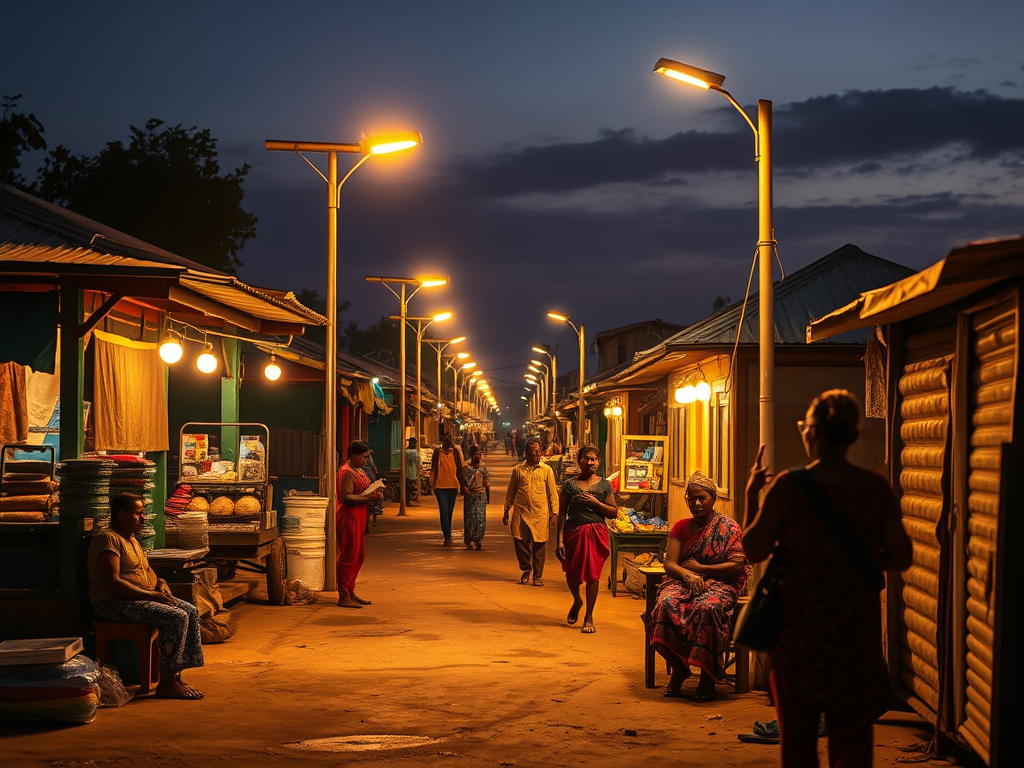
Beyond illumination: Discover how solar street lights empower rural communities by extending business hours, improving education, and enhancing gender safety.
In rural and off-grid communities across the globe, darkness is more than an inconvenience—it’s a barrier to economic growth, education, and public safety. Grid extension is often prohibitively expensive. Solar street lights are proving to be a transformative, leapfrog technology, delivering impact far beyond simple visibility.
The Multiplier Effect of Light: Tangible Community Outcomes
- Economic Enabler: Extending the Productive Day
Market Activity: In communities like Kisumu, Kenya, installing lights in central market areas allowed vendors to operate 3-4 hours longer. Average daily incomes increased by 30%.
Micro-Enterprise: Small storefronts can stay open after sunset. Street food vendors gain critical evening business hours. A study in Rwanda showed a 22% increase in nightly transactions for lit businesses.
Tourism: Lighting paths to eco-lodges or cultural sites makes communities more accessible to tourists, creating indirect employment.
- Education Accelerator: Fighting the “Daylight Limit”
Study Hours: In off-grid villages, children often cannot study after sunset due to poor, expensive kerosene lighting. Community solar lights installed near schools or in central courtyards provide safe, free light for evening study groups, improving academic performance.
Adult Literacy & Training: Lighting enables night classes for adults, offering training in new skills after the day’s agricultural work is done.
- Gender Safety & Social Equity: Reclaiming Public Spaces
Reduced Gender-Based Violence: Well-lit paths to water collection points, sanitation facilities, and public transportation significantly increase women’s and girls’ sense of security after dark. A UN-Habitat report noted a up to 50% reduction in self-reported harassment in lit areas.
Increased Civic Participation: Community meetings can be held in the evening, allowing more residents, including women, to participate in local decision-making.
- Health & Wellbeing:
Reduced Accidents: Illuminated paths reduce trips, falls, and animal-related incidents.
Improved Emergency Response: Light allows community health workers to navigate safely for nighttime patient visits.
The “Community-Led” Implementation Model for Success
Failed projects often stem from a top-down approach. Successful models share these principles:
Needs Assessment With the Community: Don’t assume. Hold participatory meetings to map priority areas: Is it the market, the clinic path, or the school yard?
Local Capacity Building: Train a local technician (often a young adult) on basic maintenance—panel cleaning, fuse replacement. This creates a local job and ensures sustainability.
Clear Ownership Model: Is the asset owned by the local government, a women’s cooperative, or a community trust? Define this upfront.
Simple, Robust Technology: Use lights with fewer, plug-and-play components and weather-resistant design. Avoid overly complex systems.
Financing the Project: Innovative Models
Pay-As-You-Go (PAYG) Solar Lighting as a Service: A service provider installs and maintains the lights. The community or local council pays a small monthly fee via mobile money, often cheaper than kerosene or diesel generator costs.
Carbon Credit Financing: The verified emissions reductions (VERs) from displacing diesel generators can be sold on carbon markets to fund the project.
Public-Private Partnerships (PPP): A corporate social responsibility (CSR) initiative from a business funds the installation, while the local government commits to long-term maintenance.
Measuring Impact: Beyond Lumens
Track these metrics:
Social: # of evening market vendors, attendance at night classes, community perception of safety (survey data).
Economic: Increase in nightly business transactions, reduction in household energy expenditure.
Environmental: Tons of CO2 offset, liters of kerosene displaced.
Light is a foundational infrastructure. By starting with solar street lighting, communities unlock a cascade of benefits that pave the way for broader development, proving that sustainable technology is most powerful when it serves human potential.
Internal Link Suggestion: Learn about our “Light for Society” program and how you can sponsor a community solar lighting project.