Canada
 USA
USA Japan
Japan

Form Meets Function: Integrating Solar Street Lights into Modern Architectural and Landscape Design

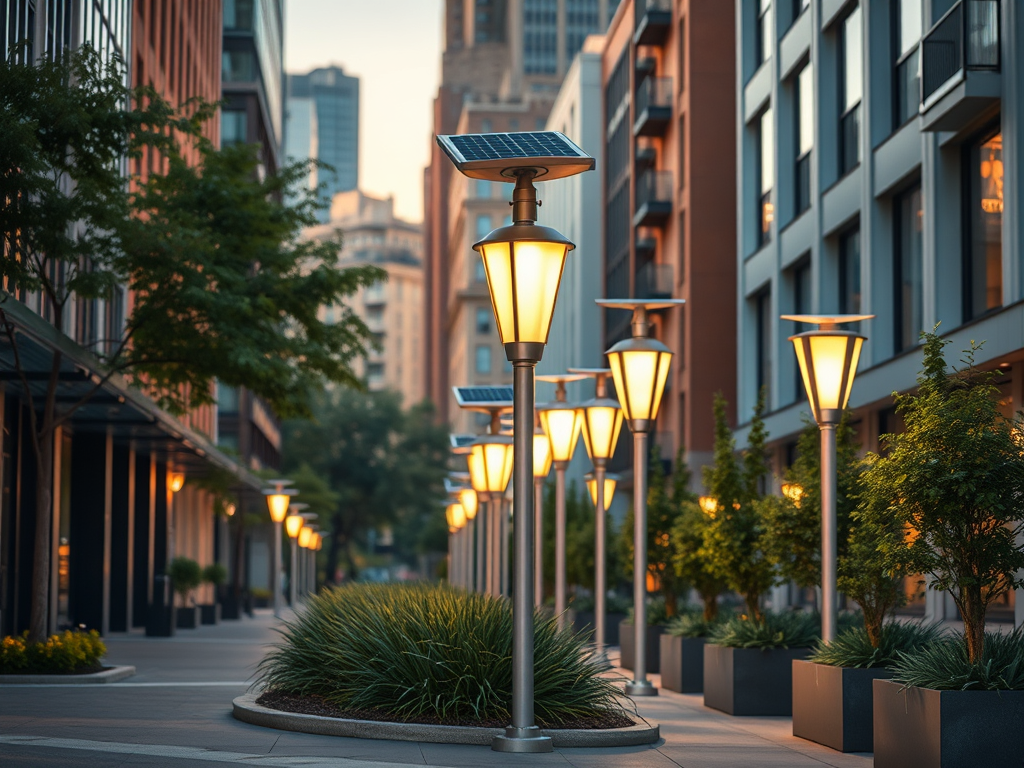
Solar lights don’t have to be utilitarian. Explore design-led solutions that blend sustainability with aesthetics for high-end developments and historic districts.
Gone are the days when “solar street light” meant a clunky box on a stick. Today, forward-thinking architects, landscape designers, and urban planners are demanding lighting that is both sustainable and beautiful. The latest generation of solar lighting offers seamless integration into any design vocabulary, from minimalist modern to classic historic.
The Design Challenge: Balancing Performance with Aesthetics
The core requirements—large solar panel, durable battery, bright LED—must be housed in a form that complements its environment. The solutions fall into three categories:
- Discreet Integration: Hiding the Technology
Pole-Integrated Panels: Sleek, triangular or cylindrical poles with building-integrated photovoltaics (BIPV). The solar cells are laminated directly onto the pole surface, creating a uniform, monolithic appearance.
Remote Panel Arrays: For historic districts where pole-top panels are prohibited, all panels can be grouped on a nearby rooftop or dedicated solar garden, connected to discreet, traditional-looking lantern-style luminaires via underground wiring.
Ground-Embedded Lights: For pathways and plazas, low-profile bollard lights with small, top-mounted panels eliminate overhead structures entirely.
- Expressive Design: Making Technology the Focal Point
Sculptural Forms: Lights designed as public art. Imagine sweeping carbon fiber arms holding panels, or geometric forms that cast intriguing shadows.
Dynamic Lighting: RGBW LEDs allow architects to program color-changing light shows for special events, turning infrastructure into experience.
Custom Finishes: Powder-coating options beyond standard gray—from matte black and bronze to custom RAL colors—allow the light to disappear into the landscape or make a bold statement.
- Context-Sensitive Solutions
Historic District Compliance: Replica gas-lamp styles with integrated solar panels and warm (2200K-2700K) LEDs that mimic the glow of flame, meeting preservation board requirements.
Corporate Campuses: Clean, linear designs with indirect lighting (light shining upward and reflected down) to reduce glare and create a sophisticated ambiance.
Parks & Waterfronts: Low-glare, shielded optics with “warm white” light (3000K) to minimize ecological disruption to wildlife while enhancing the natural setting.
Technical Considerations for Designers:
Performance Trade-offs: A smaller, integrated panel may require a higher-efficiency (and more expensive) monocrystalline cell to meet energy needs.
Thermal Management: Elegant, sealed designs must still dissipate heat from the LED and battery. Look for designs with hidden convection vents or phase-change materials.
Maintenance Access: A beautiful, seamless housing must still allow access to the battery and controller for replacement. Magnetic or tool-less access panels are key.
Case Study: The “Solar Willow” – San Francisco Bay Trail
Challenge: Light a scenic trail without introducing visually intrusive poles or trenching through protected wetlands.
Solution: A custom-designed “tree” with branches holding solar panels, supporting downward-facing luminaires. The organic form blends with the environment, and the elevated panels avoid shading from trailside vegetation.
Outcome: Achieved required illuminance with a light pollution footprint 70% lower than standard fixtures, winning a design excellence award.
Collaborative Specification Process:
Early Engagement: Involve the solar lighting supplier during the conceptual design phase.
Performance Modeling: Use 3D models and photometric software to test custom designs before prototyping.
Prototype & Mock-up: Always install a full-scale prototype on-site for review under day and night conditions.
Solar lighting is no longer an engineering afterthought. It is a design element that can—and should—elevate the aesthetic quality of our public and private spaces while delivering on sustainability promises.
Internal Link Suggestion: Browse our portfolio of award-winning design-forward solar lighting projects