Canada
 USA
USA Japan
Japan

Do Solar Street Lights Work in Winter? A Guide to Snow, Short Days, and Cold Weather Performance

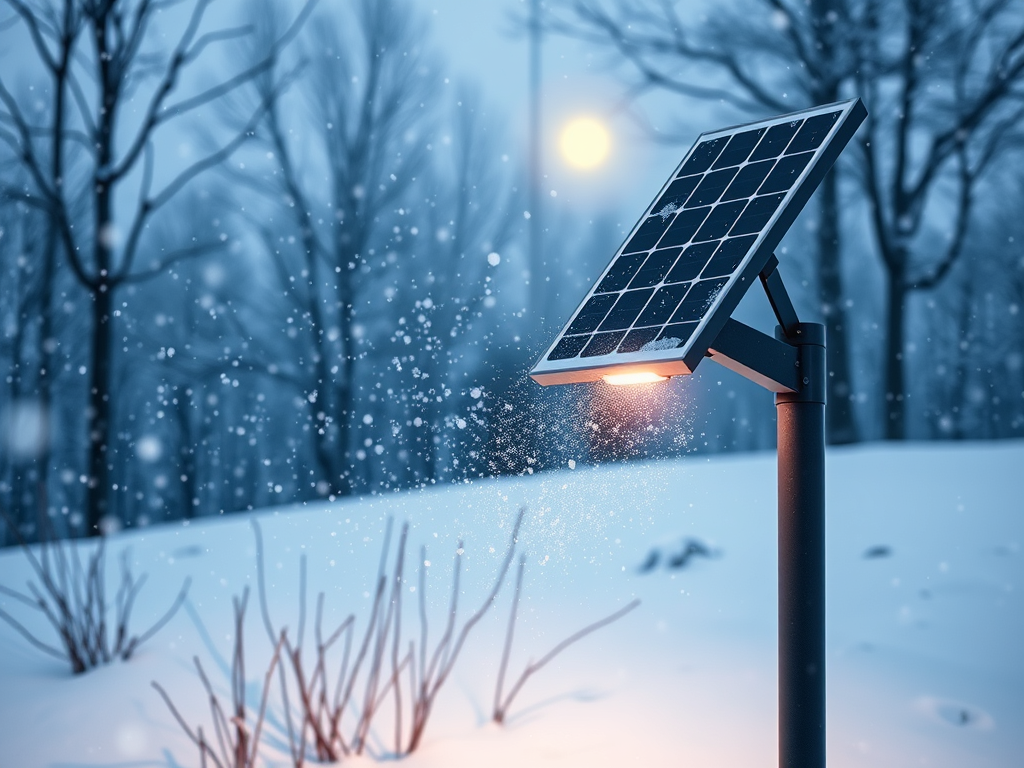
Worried about solar lights in winter? Learn how proper design ensures reliability through snow and short days. We cover panel tilt, battery choice, and snow shedding.
This is the most common concern from clients in northern states, Canada, and Europe: “If the days are short and the panel is covered in snow, will the lights work all night?” The answer is a definitive yes—if the system is correctly engineered for winter conditions. Here’s how to guarantee year-round performance.
Challenge 1: Reduced Sunlight Hours & Lower Sun Angle
The Problem: In winter, you have fewer charging hours, and the sun is lower in the sky, reducing solar intensity.
The Engineering Solution:
Oversize the Solar Panel: The panel’s wattage rating is based on ideal lab conditions. For winter reliability, we recommend a panel that is 3.5 to 4 times the wattage of the LED light. A 120W light needs a 420W+ panel.
Optimize the Tilt Angle: The default “latitude” tilt is for annual average. For winter maximization (Oct-Mar in the Northern Hemisphere), increase the tilt to Latitude + 15°. This presents the panel more directly to the low winter sun.
High-Efficiency Mono Panels: Use panels with >22% efficiency to capture every possible photon on a short winter day.
Challenge 2: Snow Accumulation on the Panel
The Problem: A completely covered panel generates zero power.
The Engineering Solution:
Steeper Tilt Angle is Key: The optimized winter tilt (Latitude + 15°) is also the best snow-shedding angle. Snow slides off more easily.
Smooth, Anti-Reflective Coating: Quality panels have a glass surface that is hydrophobic, encouraging snow to slide off.
Panel Placement: Mount the panel high on the pole (at least 18ft) to avoid snow drifts from the ground.
Heat as a Last Resort: Some advanced controllers have a “snow melt” mode that applies a small reverse current to the panel to generate warmth, but this consumes battery power.
Challenge 3: Battery Performance in Freezing Temperatures
The Problem: All batteries lose capacity and can be damaged if charged while too cold.
The Engineering Solution:
Choose LiFePO4 (LFP): It suffers less capacity loss in cold than Lead-Acid or standard Lithium-Ion (NMC). A quality LFP battery retains >80% capacity at -20°C (-4°F).
Integrated Heating & Insulation: Premium systems include a heated battery compartment that turns on only when temperatures drop below freezing, powered by a small portion of the day’s solar harvest. This prevents damage and maintains capacity.
Battery Management System (BMS): The BMS must have a low-temperature charge cutoff to prevent charging a frozen battery, which is a primary cause of failure.
Challenge 4: Increased Lighting Demand
The Problem: Winter nights are longer, requiring more hours of operation.
The Engineering Solution:
“Days of Autonomy” Design: The system must be designed for the longest night of the year. We spec for 5-7 days of autonomy, meaning the battery can run the light for a full week with zero sun—covering extended snowstorms.
Adaptive Dimming: Use smart controls to dim lights during low-traffic hours (e.g., midnight to 5 AM) to conserve battery, extending runtime.
The “Winter-Ready” Specification Checklist:
Solar Panel Wattage = LED Wattage x 3.5 (minimum).
Panel Tilt Angle adjustable to Latitude + 15°.
Battery: LiFePO4 chemistry with minimum 5-day autonomy.
Controller with low-temperature charge protection.
Optional: Heated battery compartment for zones with consistent temps below 20°F.
Real-World Data from Minnesota, USA:
A 2022 installation of 50 lights (built to the above specs) recorded 99.8% uptime through a winter with 145 inches of snow. Lights dimmed to 50% from 1 AM – 5 AM to conserve energy during the longest nights, with no negative feedback.
With proper engineering, solar street lights are not just for sunny climates. They are a robust, reliable solution for some of the world’s most challenging winter environments.
Internal Link Suggestion: Our “Arctic Series” lights are specifically engineered for extreme cold and snow. View the winter performance test data.