Canada
 USA
USA Japan
Japan

Built for the Extremes: Engineering Solar Street Lights for Desert Heat and Coastal Corrosion

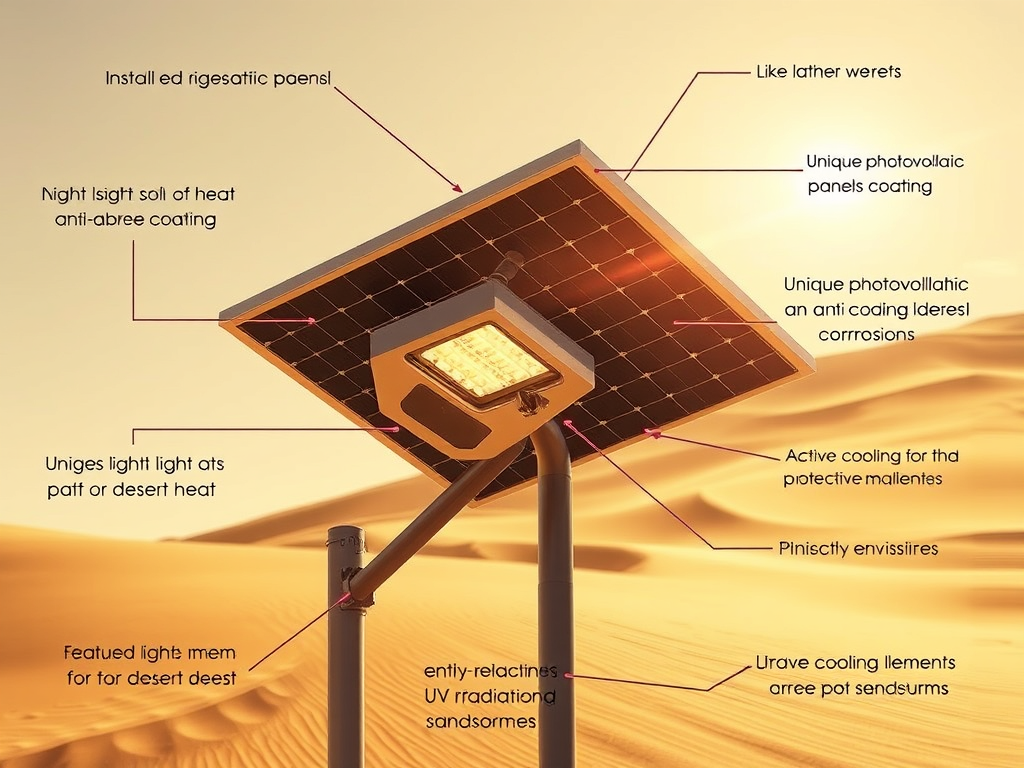
Standard lights fail fast in harsh climates. Learn the specialized engineering for solar street lights to survive desert heat, coastal salt, and sandstorms.
Solar street lights installed in Phoenix, Arizona or on the coast of Dubai face a brutal set of challenges that standard commercial units are not built to withstand. Extreme UV radiation, 130°F (55°C) heat, abrasive sand, and salt spray can cause catastrophic failure within months. Engineering for these environments requires a purpose-built approach.
Part 1: Conquering the Desert – Heat, Sand, and UV
Challenge A: Photovoltaic Efficiency Loss & Thermal Runaway
Problem: Solar panel efficiency drops 0.3-0.5% per °C above 25°C (77°F). In peak desert heat, panel surface temps can hit 80°C+, causing a 15-20% power loss. Batteries (especially NMC Lithium-ion) degrade rapidly and risk thermal runaway.
Solutions:
Panel Selection: Use panels with a low temperature coefficient (e.g., -0.26%/°C vs. -0.40%/°C). Ensure they are rated for high Maximum Operating Temperature.
Active Cooling & Ventilation: Incorporate heat sinks on the panel backsheet and thermally conductive potting to transfer heat away from cells. Use poles with passive ventilation chimneys to create airflow around the battery compartment.
Battery Chemistry: LiFePO4 is mandatory for its superior thermal stability. Install it in a white or reflective compartment to reduce solar heat gain. For extreme cases, include a thermoelectric (Peltier) cooling module powered by a small portion of the solar harvest.
Challenge B: Sand Abrasion and Dust Ingress
Problem: Sandstorms sandblast panel surfaces, reducing transparency, and fine dust (silt) infiltrates seals, damaging electronics.
Solutions:
Panel Protection: Specify panels with anti-abrasion coated glass. A slight steeper tilt helps sand slide off more easily.
Sealing Standards: All enclosures must meet IP68 rating (dust-tight, prolonged immersion). Use military-grade circular connectors (M12/M8) instead of standard waterproof plugs.
Conformal Coating: Apply a protective acrylic or polyurethane coating to all internal circuit boards to guard against conductive dust.
Part 2: Surviving the Coast – Salt, Humidity, and Hurricanes
Challenge C: Salt Spray Corrosion (The Silent Killer)
Problem: Salt mist permeates every crack, causing galvanic corrosion between dissimilar metals and destroying electronic components.
Solutions:
Material Science: Use marine-grade aluminum (5052, 6061) with a minimum 80-micron anodized finish or hot-dip galvanized steel for poles. All fasteners must be A4 (316) stainless steel.
Coatings & Seals: Apply a salt-fog resistant topcoat over anodization. Use closed-cell silicone gaskets instead of open-cell foam.
Potting & Vapor Barriers: Pot the entire controller and battery management system (BMS) in thermally conductive epoxy. Use desiccant breather valves to equalize pressure while blocking moisture.
Challenge D: High-Wind & Hurricane Loads
Problem: Coastal zones face hurricanes and typhoons. Standard pole foundations will fail.
Solutions:
Wind-Load Engineering: Design to ASTM E2848 or EN 40-3-4 standards for high-wind zones (e.g., Wind Zone IV or Category 5). Use aerodynamic, perforated pole designs to reduce wind load.
Foundation Engineering: Use direct-embedment foundations with engineered backfill (e.g., flowable fill) or anchor bolt foundations with a concrete pier sized by a structural engineer for the specific soil type (often sandy, low-bearing-capacity soil).
Component Security: All components (panel, luminaire) must be secured with locking hardware (e.g., Nord-Lock washers) to prevent vibration loosening.
The “Extreme Environment” Specification Checklist:
Panel: Low temp-coeff mono, anti-abrasion glass, >22% efficiency.
Battery: LiFePO4 in a thermally managed, white compartment.
Sealing: IP68 throughout, marine-grade connectors.
Materials: A4 stainless fasteners, marine-grade anodized Al (80+ microns).
Structural: Wind-load calculated for local max, engineered foundation design.
Circuit Protection: Conformal coated PCBs, potted controllers.
Purchasing a standard light for an extreme environment is a guarantee of premature failure. By specifying these engineered solutions, you ensure your investment delivers decades of reliable service, regardless of the elements.
Internal Link Suggestion: Specify your project’s environmental challenges with our Extreme Environment Configurator and get a custom-built solution.